Showing posts with label apocalpytica. Show all posts

Thursday, April 25, 2013

Zombie Apocalypse Las Vegas

I just got back from the annual Viva Las Vegas rockabilly festival in (where else?) Las Vegas. It's my third time going, and if there's a better opportunity to see the kind of mid-century upbeat dance music I love--rockabilly, rock and roll, jump blues, western swing--I don't know where it is.

I always come back with a few hundred bucks worth of CD's. Leaving aside the current bands who play this kind of stuff, there is a mind-blowingly huge catalog of old recordings out there. Seems there were hundreds of record labels in the 40's and 50's, all recording great stuff that dedicated music nerds have saved and reissued on CD. For every Sun Records, there were dozens of tiny regional or city-specific labels who recorded some killer tracks by local bands who promptly went back to their day jobs driving trucks or whatever.

I feel like I went for a long time loving this stuff but having no idea where to find it. There are bajillions of recordings. Once you find a vein, there's so much it's almost overwhelming. Go search out Wild and Frantic, Hey DJ!; East Coast Teen Party; or Rock 'n' Roll Orgy--each of these CD series has a dozen or more volumes, all packed with great stuff. (Um, watch out googling that last one though.)

Aside from the music, the event itself is sort of like a Star Trek convention for Back To The Future nerds, right down to the ballroom full of people who are obviously not teenagers, dressed like 1950's teenagers and cutting up the floor like professional swing dancers. There's a huge classic car show which--even for a committed pedestrian like me--is pretty impressive.There are merchant booths selling vintage threads, tiki knicknacks, and industrial-strength pomades to keep your ducktail tuff.

There's a whole other post to be written sometime about the appeal of this whole subculture. Were I to summarize, I would say that there are a lot of reasons to wish it was 1955 again, if you were able to surgically remove the racism, sexism, homophobia and ubiquitous second-hand cigarette smoke.

Anyway, as per my usual habit, I went down a bit early and spent a couple of days in the old downtown around Fremont Street. That original Rat Pack, Bugsy Siegel-era center has been gussied up in recent years for slightly less seedy audiences; they've clapped a giant roof over the street, and the roof is embedded with gajillions of LED's, making it a gigantic Blade Runner flat-screen TV.

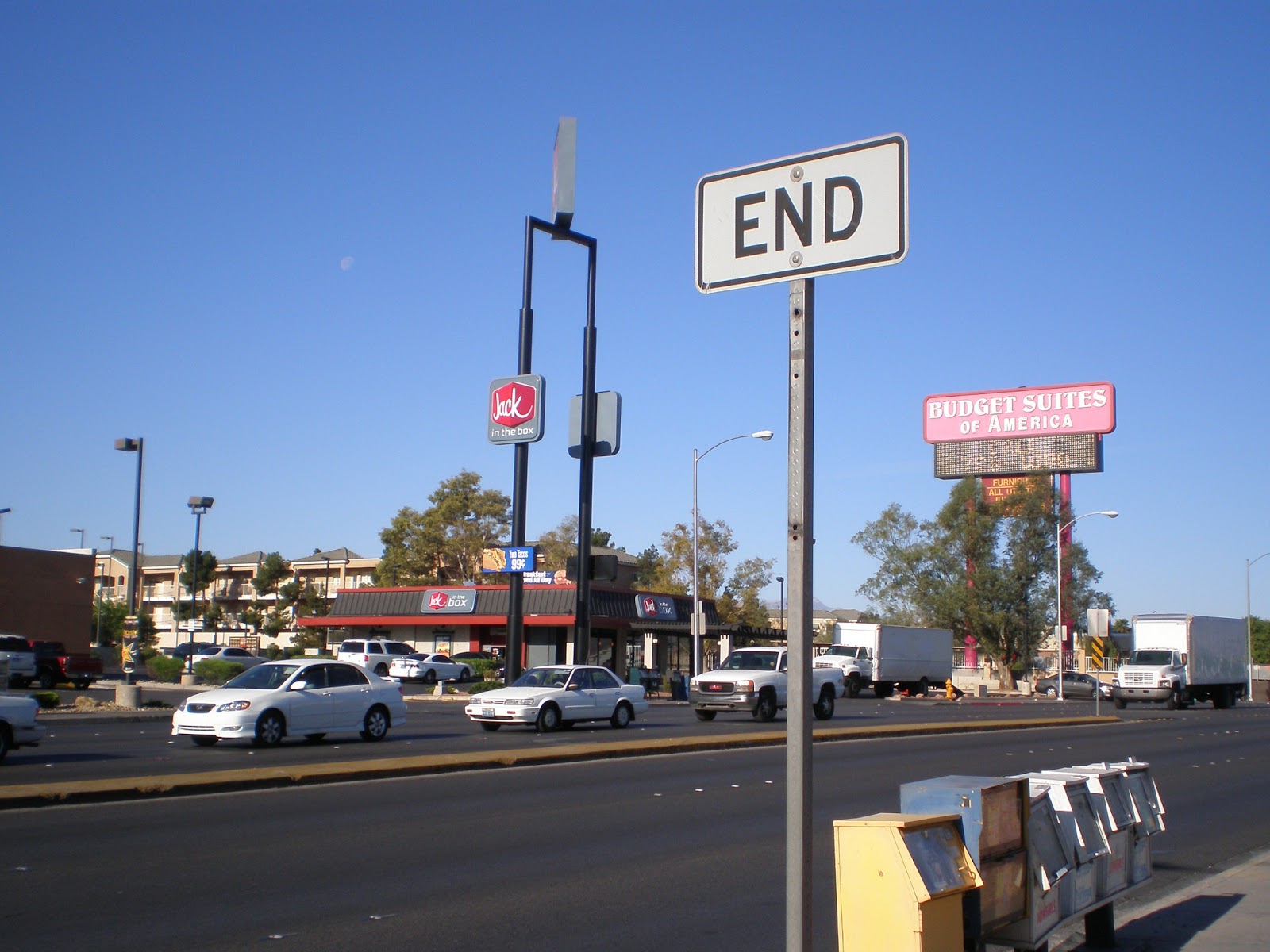
Also as is my wont when I visit a new city, I took a walk out of said tourist area. Within two blocks found myself in the most desolate, messed-up urban post-apocalyptic ruinscape I have ever seen--and I have seen my share of messed-up urban et cetera. It was like I'd walked into a parallel universe where the Cuban Missile Crisis had ended very badly indeed. Block after block of demolished (or close to it) motels, their original and now-very-retro pylon signs flaking away in the desert sun.


 Looks like you're still charging too much.

 At a certain point you just give up and fill the pool with rocks.

If Downtown and the Strip are like Blade Runner without the rain, the surrounding area was like... I dunno... Planet of the Apes without the apes.

 
You maniacs! You blew it all up.... And I really wanted a burrito!

I recently heard an episode of This American Life, talking about how federal disability insurance has largely taken over the role of welfare in the United States. This tour bears it out. Almost literally everybody I saw--and there were a few people out at eight in the morning--had a cane, a walker or some sort of mobility device. I saw a guy pushing his girlfriend around in a grocery cart. Vegas being what it is, the extremes of poverty are probably particularly visible. But it looks like there are whole districts that subsist entirely on federal Social Security.... and this is what they're like.

The next day I took the bus out to something called the Zombie Apocalypse Store. It's a ridiculously stupid, not to mention awesomely cool, little store that sells all manner of stuff you would need to survive the hordes of living dead. Machetes, ammunition, army MRE's, first aid kids.

I thought about asking them for a ride back to the hotel but I didn't like the look of the guy they'd already picked up.

The Zombie Apocalypse Store is located out the Clark County exurban sprawl, in the middle of a vast, depopulated, de-industrialized wasteland of abandoned one-storey industrial buildings, many of which formerly sold granite countertops and other necessities for the great twenty-first century housing bubble which now, five years after popping, feels like a whole other world. As I trudged back to the hotel, I thought it was one of the few places on earth where a zombie apocalypse would be an improvement. At least there would be someone walking around.

Wednesday, September 22, 2010

Mad Max

You need to be careful about attributing too much meaning to movies, especially big noisy action movies. Reading the cinematic tea leaves for deep relevance to the world of today is a mug's game, or at least a game for those poor souls who have opted to do graduate studies in film.

At the same time, part of what makes a movie work is how it taps on our familiar experience and resonates in the audience's mind. Any movie, if it's any good, is a little bit true--even if it's an over-the-top fantasy.

Idle Primate and I went out to see Mad Max recently. That's the first of George Miller's postapocalyptic trilogy set in the Australian outback and arguably the least iconic of the three. When people talk about a "Mad Max dystopia," they're usually referring to The Road Warrior, the second film in the trilogy, set after a nuclear war. That's a very simple world--rampaging motorized gangs of punk rock mutants in a completely lawless post-nuclear wasteland, where civilization is clearly and indisputably dead and gone.

Mad Max is more interesting in that it takes place while things are falling apart. It's not post-apocalyptic so much as... well, I guess pre-post-apocalyptic is the best word. (Which technically should just be "apocalyptic" but it's not really that either, because apocalypse suggests a clear and sudden transition and that's not really what's going on here.)

Max and the other good guys are highway-patrol cops, chasing down the first generation of the emerging road gangs that will have completely taken over by the time we get to The Road Warrior. It's clear that the police force is on its last legs as a civic institution; the cops themselves are starting to look and behave like just another (albeit relavitely benign) gang operating out of the trashed-out remains of the Halls of Justice.

But what's striking is that no one seems to think the world has ended. Notwithstanding the obvious failure of major institutions that is underway, a good chunk of the movie involves Max and his Sears-catalog family piling into the station wagon and going on a pleasant road trip, even though we know those roads are full of biker gangs. The bikers themselves are kind of goofy and clean-cut--a missing link, the last of the 1960's-style bikers, sort of a coelocanth-like specimen of pre-Altamonte Hell's Angel, from just before it split once and for all from the hippie genus and became something vicious and malignant. The kind of bikers you would imagine doing security for the Monkees.

At the same time, ambulances still come when you call them; lawyers still show up to get their clients out of jail; whiskey and hookers are still bought with money, not cans of Spam.

So the film and its characters exist in this odd space of apocalypse denial. In this respect Mad Max is a much more realistic film than The Road Warrior.

The big problem I have with survivalists and hard-core doomers is not that they anticipate some serious shit going down; it's that they seem to expect and even hope for a very clear-cut situation to emerge afterwards, where life is a matter of having lots of guns and being willing to use them. Where all complications of society, rules, expectations and having to deal with other people are swept away, and where life--if nasty, brutish and short--is at least freed from bullshit.

But as we've seen in Russia and Afghanistan and even the late Roman/early Frankish period, civilizations don't collapse that neatly. There is never any clear-cut signal that says, "NOW it is necessary and okay to quit mailing out resumes, pick up a machine gun and start marauding." You can lose and lose and lose some more--retirement plans, public schools, the rule of law--and yet that blessed state of nature never seems to come. The survivalists and Tea Partiers are bound to be disappointed. Just what does someone have to do to get a Hobbesian war of all against all going around here, anyway!

Of course, in Mad Max, the title character gets just that signal. Something Changes Forever and the hero is freed from all obligation to the old world, freed to become the Road Warrior.

It's only a movie, guys.

What's really interesting is how plausible even the implausibilities are. In this crumbling world, where even the police station looks like a trashed-out squat, the roads are still being maintained with beautiful smooth asphalt, well enough to drive on at eighty miles an hour. Absurd on the surface of it; roads are fragile and take an insane amount of effort and coordination to keep functional at all, and in a general center-not-holding-things-falling-apart those roads should turn into cowpaths right quick. Except that in real life, while civic institutions such as schools and city halls and libraries have to close due to collapsed tax bases, the half-assed thrashing of governments trying to jumpstart the economy is largely directed towards road building. Suddenly Mad Max seems eerily prescient.